
A round of Wheel Out lasts a few seconds and comes down to one question: how far does the tire get before something stops it? You launch once, the wheel rolls down a desert track collecting values and multipliers, and the run ends the instant it hits a Wall or simply runs out of track. There is no manual cash-out, which is the single most important thing to understand before you stake real money. This page is about the round logic itself. For the full symbol list see the symbols page, and for the buttons see how to play.
One launch, one outcome
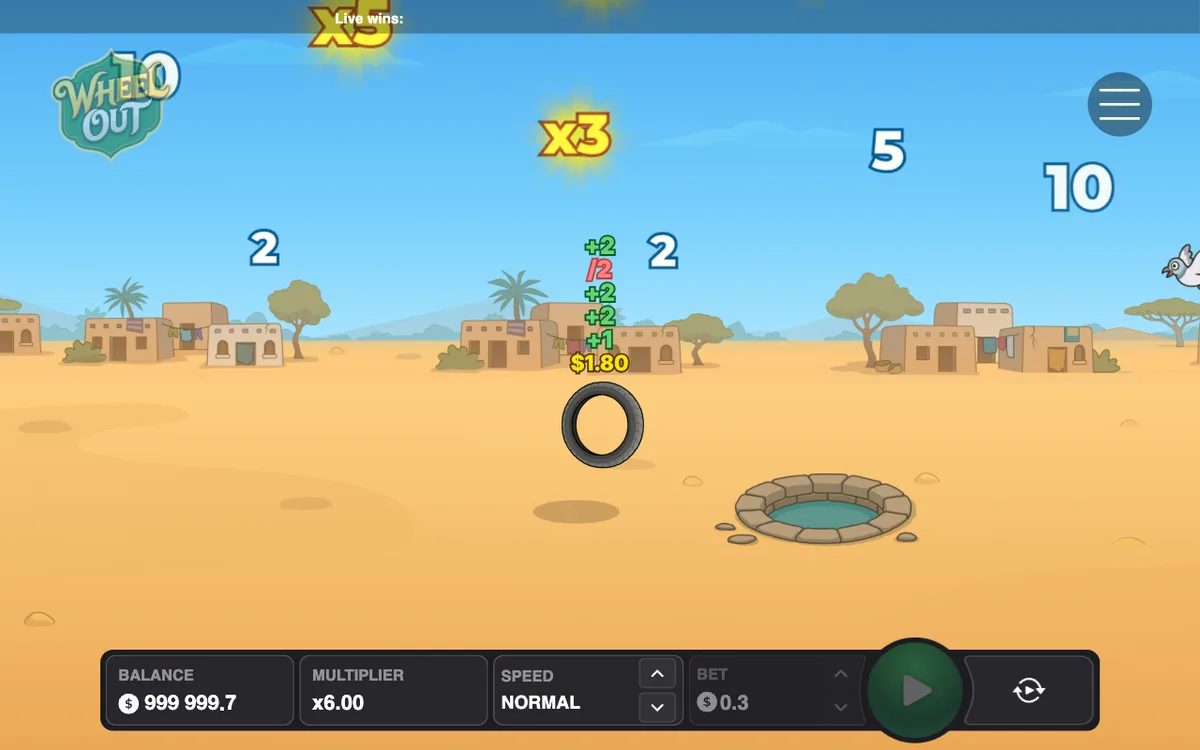
Press the green button and the bet leaves your balance immediately. From that moment you are a spectator. The tire gets flung off a ramp, and as it travels it passes floating tokens that either add to a running total, multiply it, halve it, or kill the run outright. Above the wheel a little stack of the collected symbols builds in real time, and the Multiplier readout on the control bar ticks up alongside it.
When I ran my first round on Normal speed, the sequence read +2, then a red /2, then +2, +2, +1, and the total on screen hit $1.80 at a x6.00 multiplier before a Wall ended it and paid nothing. Total elapsed time: maybe four seconds. That is the whole game loop, repeated.
What decides how far the wheel goes?
The honest answer is a random number generator, not skill. Wheel Out is an instant-win game, so each launch is an independent event with a pre-determined result the moment you commit the stake. Your speed setting changes how fast the animation plays out, but as far as I can tell it does not change the odds. Pressing later, tapping the screen, choosing Ultra over Slow - none of it nudges the maths. Anyone telling you there is a “launch technique” is selling something.
Win, halve, or bust
Three things can happen to your running total as the wheel travels.
- It grows. Pluses and multipliers stack. A x5 landing on a decent base is where the exciting rounds come from.
- It shrinks. The pigeon token (/2) cuts your current winnings in half. I watched two pigeons in a row gut a promising run down to loose change.
- It ends. A Wall busts the round to zero, and a raven stops the wheel. Either way, whatever was on the board can vanish if the run dies before it banks.
Because the total only pays if the wheel resolves without busting, a round that looked like a winner two seconds ago can pay nothing. That gap between the on-screen tally and what actually lands in your balance is the crux of the game, and it is exactly why the no-cash-out design stings.
Why no cash-out changes your strategy
In Aviator you decide when to bank a rising multiplier, so the pressure is on your reflexes. Wheel Out takes that decision away. You choose one thing only - the stake - and then the round plays itself. Compared to a manual crash game, that makes bet sizing more important, not less, because it is your single lever. I cover how I would size it on the strategy page.
Where the design frustrates
Two things bugged me. First, the lack of a cash-out removes the skill fantasy that makes crash games moreish; some players will find that liberating, others will feel robbed of agency. Second, InOut does not publish a hit-frequency figure, so I cannot tell you how often a round busts early versus pays - I only have what I saw across my own sessions, which is not a large enough sample to quote as fact. I would rather flag that gap than invent a number.
Deposits, in one line
The round logic is the same everywhere, but banking is set by the casino, not the game: expect cards, e-wallets like Skrill or Neteller, and crypto, with instant deposits and withdrawal times that vary by site. Check the cashier before you play for real.
Does the speed setting change my odds in Wheel Out?
No. Slow, Normal, Fast and Ultra only change how quickly the animation plays. The result is set by the RNG when you place the bet, so speed is cosmetic.
Can I stop the wheel or cash out early?
No. Once you launch, the round resolves automatically. There is no button to bank the running total mid-flight, which is what separates Wheel Out from manual crash games like Aviator.
Why did my round show a win then pay nothing?
The tally above the wheel is a running total, not a locked win. If the wheel hits a Wall before it resolves, the round busts to zero even if it briefly showed a positive figure.
Sources
- InOut Games’ official Wheel Out page - confirms the instant-win format and 96.5% RTP.
- The Gambling Commission on how RNG games work - background on why each launch is independent.